Compliance Corner: Navigating the Regulatory Realm |
|
U.S. EPA Issued New Source Performance Standards for Stationary Combustion Turbines and Stationary Gas Turbines at 40 CFR 60 Subpart KKKKa
The revised New Source Performance Standards (NSPS) subpart is applicable to affected sources constructed, modified, or reconstructed after December 13, 2024. The new regulation makes several amendments to 40 CFR Part 60, Subpart KKKK, although it does not overhaul the core NOx standards for existing KKKK sources. Instead, it adds clarifications, flexibilities, and alternative compliance pathways. (New Source Performance Standards Review for Stationary Combustion Turbines and Stationary Gas Turbines, 91 Fed. Reg. 1910 (Jan. 15, 2026) (to be codified at 40 C.F.R. pt. 60).
New EPA Webpage Provides Clean Air Act Guidance to Support Permitting, Building of U.S. Data Centers and AI Facilities
The new website (https://www.epa.gov/stationary-sources-air-pollution/clean-air-act-resources-data-centers) provides a central location for those looking to learn more about CAA regulations, guidance, and technical tools that can assist with modeling, air quality permitting, and regulatory interpretations relevant for data centers and AI facilities. This work follows the U.S. EPA’s May 2025 regulatory interpretation of the National Emission Standards for Hazardous Air Pollutants (NESHAP) for Reciprocating Internal Combustion Engines (RICE) while it evaluates more substantive changes. U.S. EPA has determined that certain engines can operate for up to 50 hours per year in non-emergency conditions to supply power to the U.S. grid and maintain reliable service as part of a financial arrangement with another entity (https://www.epa.gov/stationary-engines/national-emission-standards-hazardous-air-pollutants-reciprocating-internal-0). Reciprocating Internal Combustion Engines are used in a variety of applications including as power back-up for data centers and AI facilities. Thousands of these engines are located across the U.S. and other countries.
AQMIS makes managing emissions inventories easy. The 50-hour non-emergency provision can be coded into AQMIS and tracked to manage compliance at your facility. Additionally, AERMOD View and CALPUFF View simplify modeling requirements in support of permitting and on-going compliance with air quality standards, especially when the Modeling Module is included in your AQMIS package. Contact us today to learn more about how our software solutions simplify environmental compliance!
|
|
Online CALPUFF Course with CASANZ – March 24-27, 2026 |
 |
Together with the Clean Air Society of Australia & New Zealand (CASANZ), we will hold an online CALPUFF air dispersion modeling course. Training will take place in four, 4-hour webinars from March 24 to 27, 2026 from 9:00am to 1:00pm (Australian Eastern Daylight Time) daily.
Register today!
Note: The above course will be based specifically on regulations for the Australia/New Zealand region.
|
|
Online AERMOD Training Course – Apr 7-8, 2026 |
 |
Register today for our next available 2-day online AERMOD course taking place on April 7 and 8, 2026 from 8:30am to 5:00pm (Central Time – Chicago, USA).
Register today before space is gone!
Note: Due to the immense popularity of our online courses and small class sizes, we recommend registering and making payment as soon as possible to reserve your spot.
|
|
Just Announced – New Online AERMOD and CALPUFF Courses! |
 |
We’re excited to announce the following upcoming Online AERMOD and CALPUFF Air Dispersion Modeling Courses. Experience world-class training led by our senior air quality experts, all from the comfort of your home or office.
Online registration is open! Our online courses tend to fill up quickly, so we encourage you to register and complete your payment as soon as possible to secure your spot.
Don’t miss out—sign up today!
|
|
UPCOMING TRAINING COURSES |
|

|
MODELING TIP |
When Numerical Values Are Outside AERMOD’s Default Threshold |
|
A standard model run using the AERMOD air dispersion model produces numeric output with up to 13 significant figures (e.g., xxxxxxxx.xxxxx). Projects which use very low or very high emission rates may run into a problem where the values output by the model do not fit properly within this limit. For example, concentration values of 1E9 units or higher will result in a field of asterisks written to the output file as shown below.
ALL HIGH 1ST HIGH VALUE IS************** ON YYMMDDHH: AT ( XXXXXX.00, YYYYYYY.00, ZZZ.00, HHHH.00, 0.00) GC UCART1
Concentrations which are below or very near to the default reporting threshold (1E-5) will result in repeating values of 0.00000 or 0.00001. With so many repeating values, AERMOD View becomes unable to properly generate contours due to the lack of precision.
The AERMOD model features two ways to handle this issue.
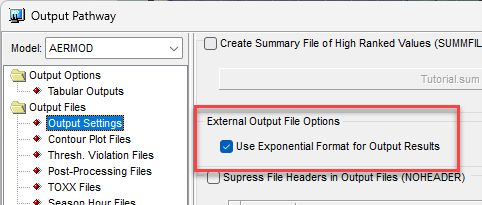
- Write the data in exponential format. In the Output Pathway under Output Settings, enable the option to “Use Exponential Format for Output Results”. This will report all values in the external output files (e.g., Contour Plot Files, PLOT-formatted Post-Processing Files, etc.) using scientific notation so that the numeric values are fully written.
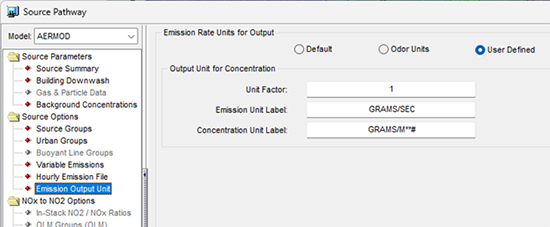
- Edit the model’s unit labels. In the Source Pathway, go to the Emission Output Unit settings. The default settings use GRAMS/SECOND as the emission label and MICROGRAMS/M**3 as the concentration unit with a unit factor of 1E6. By selecting the User Defined option, the modeler can edit the unit factor and labels as needed.
For example, a unit factor of 1 and a concentration label of GRAMS/M**3 will print numeric values for very high results. Alternatively, a unit factor of 1E12 and a concentration label of PICOGRAMS/M**3 will display very low results.
|
|

|
ENVIRONMENTAL NEWS ARTICLES |
Scientists Break ‘Decades of Gridlock’ in Climate Modeling |
February 5, 2026 - Global climate models capture many of the processes that shape Earth’s weather and climate. Based on physics, chemistry, fluid motion, and observed data, hundreds of these models agree that more carbon dioxide in the atmosphere leads to hotter global temperatures and more extreme weather.
Read more → |
|
Forest Soils Increasingly Extract Methane from Atmosphere |
February 4, 2026 - Forest soils have an important role in protecting our climate: they remove large quantities of methane – a powerful greenhouse gas – from our atmosphere. Researchers from the University of Göttingen and the Baden-Württemberg Forest Research Institute (FVA) evaluated the world's most comprehensive data set on methane uptake by forest soils.
Read more → |
|
|
|
UPCOMING CONFERENCES |
2026 Conference Schedule |
|
TCEQ Environmental Trade Fair and Conference (ETFC)
May 19-20, 2026 | San Antonio, TX | Booth #522
Learn more →
Air & Waste Management Association’s 119th Annual Conference & Exhibition
Jun 21-24, 2026 | Austin, TX | Booth #401
Learn more →
|
|
|
LAKES SOFTWARE GROUP OF COMPANIES
|
 |
1-170 Columbia St. W.
Waterloo, ON N2L 3L3
View Online
This newsletter contains information gleaned from various sources on the web, with complete links
to the sources cited. Organizations cited are in no way affiliated with Lakes Environmental Software.
For more information, please visit our web site at: www.webLakes.com.
All comments and suggestions are welcome. You can e-mail us at: support@webLakes.com.
Privacy Policy |
|
| | | |