Compliance Corner: Navigating the Regulatory Realm |
|
Recent U.S. EPA Actions Relevant to Air Quality Management
On November 21, 2025, the U.S. Environmental Protection Agency (EPA) issued a press release summarizing Agency accomplishments in 2025. Among these were three developments relevant to air quality management and permitting.
Action 1:
EPA issued an Interim Final Rule modifying requirements for temporary-use Commercial and Industrial Solid Waste Incinerators (CISWI) used during natural disaster debris removal. The rule provides state, local, and Tribal authorities greater flexibility to manage debris in emergency situations. Under qualifying emergency declarations, CISWI units used solely for debris combustion are not subject to Clean Air Act section 129 emission standards, provided they meet the conditions of the temporary-use provisions. The rule became effective August 26, 2025 (90 Fed. Reg. 41508). The public comment period closed October 10, 2025, with one submitted comment.
Action 2:
EPA finalized a report addressing particulate action levels associated with metal emissions from lithium-ion battery fires. As part of this effort, the EPA Lithium-Ion Battery Taskforce (LIBTF) released the EPA On-Scene Coordinator Lithium-Ion Battery Response Guide (October 2025). Attachment 3 of the guide includes short-term inhalation-based action levels, expressed as PM10 (µg/m³), to support emergency response decision-making.
https://response.epa.gov/sites/16141/files/EPA%20OSC%20Lithium-Ion%20Battery%20Response%20Guide.pdf
Action 3:
EPA completed 10 recent Clean Air Act regulatory actions in Region 1, including five final State Implementation Plan (SIP) approvals. Review of Federal Register notices from April through November 2025 indicates activity across Rhode Island, Connecticut, Vermont, and Massachusetts, with most actions pertaining to Connecticut. These developments may have implications for air permitting processes within these states.
Lakes Environmental Software’s air dispersion modeling and risk assessment tools support evaluations related to CISWI operations, emergency response planning, and Clean Air Act permitting applications.
|
|
Happy Holidays from Lakes Environmental!
|
 |
As 2025 comes to a close, we want to take a moment to say thank you - to all our clients and subscribers - for making this year such a success. Your support and trust mean the world to us, and it’s because of you that we love doing what we do every day.
Wishing you a joyful holiday season and a happy, healthy New Year! We’re excited to continue working together in 2026 and making it another fantastic year. Lakes Environmental will be closed the following days during the holidays:
December 24 |
Closed |
December 25 |
Closed |
December 26 |
Closed |
January 1 |
Closed |
January 2 |
Closed |
If you have an urgent matter requiring assistance during the holidays, please e-mail us at support@webLakes.com and we will respond to your inquiry as soon as we are back in the office.
|
|
Online CALPUFF Training Course – Jan 27-28, 2026 - Only a Few Spots Left! |
 |
Our next available 2-day online online CALPUFF course is filling up quickly. Join us on January 27 and 28, 2026 from 8:30am to 5:00pm (Central Time – Chicago).
Led by our expert instructors, this course offers in-depth instruction and hands-on exercises designed to help you effectively apply the CALPUFF modeling system in real-world scenarios.
Secure your spot by registering today!
|
|
Online AERMOD Training Course – Feb 17-18, 2026 - Filling Fast! |
 |
Register today for our next available 2-day online AERMOD course taking place on February 17 and 18, 2026 from 8:30am to 5:00pm (Central Time – Chicago, USA).
Register today before space is gone!
Note: Due to the immense popularity of our online courses and small class sizes, we recommend registering and making payment as soon as possible to reserve your spot.
|
|
|
UPCOMING TRAINING COURSES |
|

|
MODELING TIP |
Time Series Output from AERMOD |
|
The AERMOD model can produce many different forms of output to support modelers’ needs. For example, highest values (or ranked values) tables are probably the most common form of output. These tables contain concentrations which are not paired in time across the domain but ranked in order from highest to lowest at each individual receptor.
Some situations may require the modeler to analyze time series output as opposed to maxima. For these tasks, AERMOD can prepare an output file called the Post-Processing File (model keyword POSTFILE).

Post-Processing File Options in AERMOD View
Each POSTFILE requires a few input elements:
- Averaging Period: Select the time step you want to analyze. Output for each receptor at each time step will be written to the file. In the screenshot above, output at every single-hour interval would be published.
- Source Group ID: Identify the source group of interest. You can create one POSTFILE for each Averaging Period + Source Group ID combination.
- Format: Choose from binary (UNFORM) or ASCII text (PLOT). Use the latter if you want to analyze the output using third-party software (e.g., large text file editors) as the binary option will not be readable.
- File Name: Assign a unique file name.
In addition to manually creating Post-Processing Files using the above settings in the Output Pathway, AERMOD View utilizes the POSTFILE output in other ways, as well. Under the Lakes Tools settings in the Output Pathway, you will find the Percentile / Rolling Average and Plume Animation features.
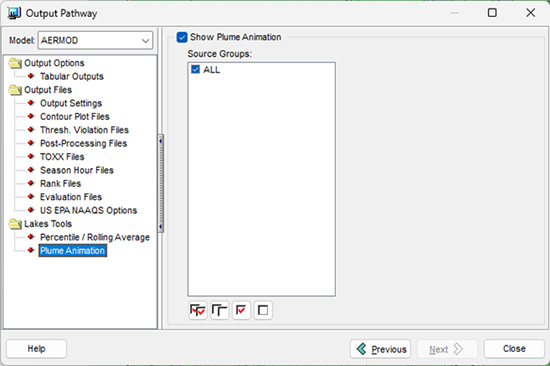
Plume Animation File Options in AERMOD View
The Plume Animation option creates a 1-hour average POSTFILE for each selected source group which the application subsequently uses to display the concentration contour plots for each time step. Users can then animate and record these using the Multimedia menu.
One important thing to keep in mind about POSTFILEs is that they can be prohibitively large in size. You need to make sure you have adequate disk space before starting your model run to avoid run failures.
|
|

|
ENVIRONMENTAL NEWS ARTICLES |
Antarctica’s Irregular Heartbeat Shows Signs of Rapid Melting |
December 11, 2025 - Periods of sudden melting in the Antarctic ice sheet have been unearthed in a new climate record from over 20 million years ago by geoscientists led by the University of Leicester and the University of Southampton.
Read more → |
|
Feeding Grazing Cattle Seaweed Cuts Methane Emissions by Almost 40% |
December 3, 2025 - Seaweed is once again showing promise for making cattle farming more sustainable. A new study by researchers at the University of California, Davis, found that feeding grazing beef cattle a seaweed supplement in pellet form reduced their methane emissions by almost 40% without affecting their health or weight.
Read more → |
|
|
|
UPCOMING CONFERENCES |
2026 Conference Schedule |
|
TCEQ Environmental Trade Fair and Conference (ETFC)
May 19-20, 2026 | San Antonio, TX | Booth #522
Learn more →
Air & Waste Management Association’s 119th Annual Conference & Exhibition
Jun 21-24, 2026 | Austin, TX | Booth #401
Learn more →
|
|
|
LAKES SOFTWARE GROUP OF COMPANIES
|
 |
1-170 Columbia St. W.
Waterloo, ON N2L 3L3
View Online
This newsletter contains information gleaned from various sources on the web, with complete links
to the sources cited. Organizations cited are in no way affiliated with Lakes Environmental Software.
For more information, please visit our web site at: www.webLakes.com.
All comments and suggestions are welcome. You can e-mail us at: support@webLakes.com.
Privacy Policy |
|
| | |