

AERMOD, one of the most widely-used air dispersion models in the world for analyzing ambient air pollutant concentrations, is typically applied for a wide variety of buoyant and neutrally-buoyant releases. One recurring question about the model is what pollutants it can (or cannot) model. Coded into the model is a list of pollutant types used to identify the pollutant being modeled for a particular run.
In AERMOD View, the Pollutant Type list is available in the Control Pathway’s Pollutant / Averaging options.
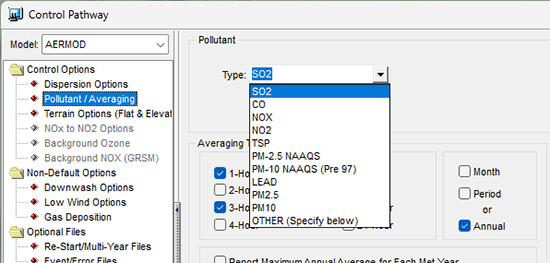
Pollutant ID List in AERMOD’s Control Pathway
Many of the Types are treated as labels with no special meaning as chemical transformations are generally not treated by AERMOD. Some pollutant names, by themselves or in combination with other model options, can affect how AERMOD computes final results. See the list below for details on these pollutants with special meaning:
- SO2
- Triggers the use of a 4-hour half-life decay when the Urban dispersion coefficient is used
- Computes the distribution of daily maximum 1-hour concentrations in accordance with the National Ambient Air Quality Standards (NAAQS) when the 1-hour period is the only short term averaging period
- NO2
- Required to use special options for simulating the conversion of NO to NO2. These options include ARM2, OLM, PVMRM, GRSM, & TTRM/TTRM2.
- Computes distribution of daily maximum 1-hour concentrations in accordance with the National Ambient Air Quality Standards (NAAQS) when the 1-hour period is the only short term averaging period
- PM-2.5 NAAQS (i.e., PM-2.5, PM2.5, PM25 or PM-25):
- Restricts averaging periods to 24-hour and ANNUAL averages
- Limits meteorological data to complete years
- The MAXDCONT option for analyzing contributions to NAAQS violations will only work across multiple years if the meteorology is provided as a single multi-year set of files (i.e., no use of the MULTYEAR option).
- PM-10 NAAQS (Pre 97):
- For generating the high-sixth-high in five years
If you don’t see the name of your specific pollutant or toxic in the list, the OTHER selection can be used to define the name of your pollutant up to 8 characters.
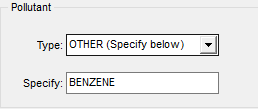
OTHER Pollutant Type
AERMOD’s code can automatically apply optional deposition parameters for specific names applied through the OTHER option. When modeling Gas Deposition, the following IDs can be specified to access values of diffusivity, cuticular resistance, and Henry’s Law constants:
- HG0 (Elemental Mercury)
- HGII (Divalent Mercury)
- TCDD (Dioxin)
- BAP (Polycyclic Aromatic Hydrocarbons)
- SO2
- NO2
For Method 2 particle deposition, fine mass fraction and mean particle diameter values are automatically associated with the following IDs:
POC (Polycyclic Aromatic Hydrocarbons)
AS (Arsenic)
CD (Cadmium)
PB (Lead)
HG (Mercury